

Is Content Creation Doomed?
Exploring the rise of generative AI and the battle for engaging writing in the Age of writing monoliths

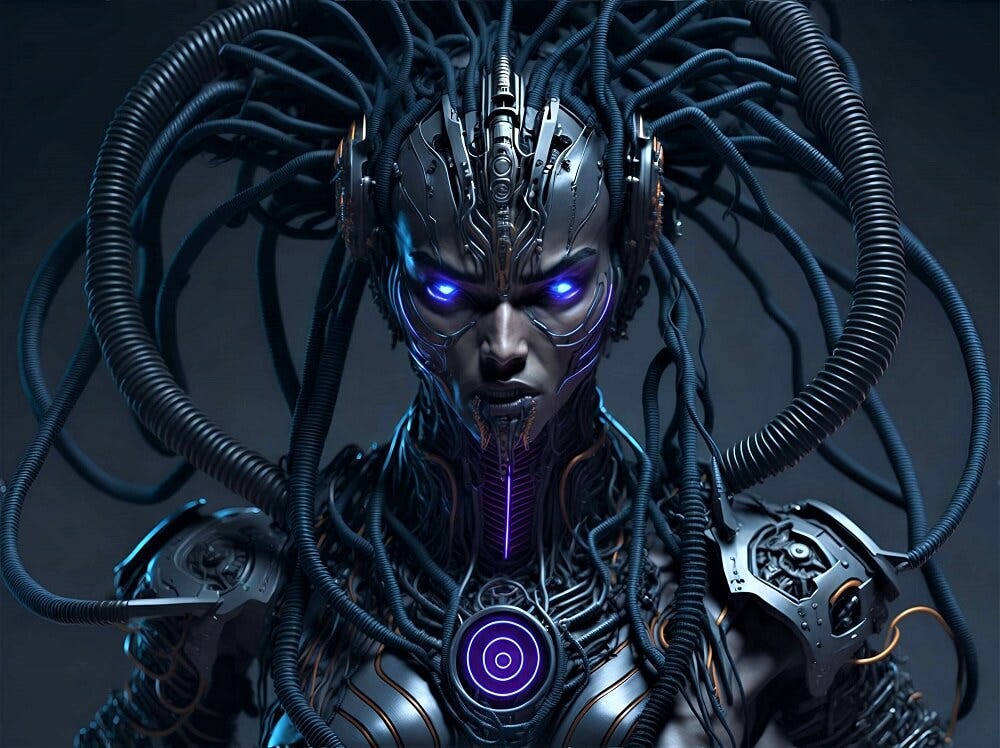
Welcome to the coming age of AI algorithms! Now that generative AI is taking over the world, is content creation doomed to die a slow death?
Before we dive into the amazing world of generative AI algorithms and their “writing monoliths,” let me tell you a short story.
There was once a very smart and wise man. He learned everything, understood everything, and took it all with him when he died.
There was another man. He was reasonably uneducated and invented a new and improved model of pencil sharpener. — Vergílio Ferreira
Which one do you think was the better man?
Please scroll down to the bottom of this piece and leave your response to my query. Then, I invite you to come back up, and I’ll let you know more about writing monoliths.
The rise of the all-knowing algorithms
AI isn’t just replacing humans; it’s also changing how we think about writing and how we experience words themselves.
We call ourselves “writers” or “authors,” but deep within, I’ve always felt more like an alchemist of words.
Ancient alchemy chased the impossible.
Some alchemists sought the transmutation of common metals into gold.
Others would devote their entire lives to seeking the elixir of life or the philosopher’s stone.
When I sit down to write, I truly feel like an alchemist.
Writing feels like magic. It’s as if I can leave everything mundane behind.
Thus, I can only gain clarity when I take a step back, allowing the clamoring voices in my head a chance to be heard.
Only then do I tap into my true self and meet all my writing surrogates.
AI assistance takes away the magic of creativity.
Talking about writing alchemy, please allow me to ask you another question.
Have you found fundamental words?
The words that remain after all the hustle and bustle of living.
The ones you hear only when everything else falls silent
The words that will outlive you.
AI feels like magic, right?
With the help of AI, anyone can have access to powerful tools able to write copy faster than a human writer can blink.
However, AI will never help you find your magical words.
AI is just a stepping stone toward the age of writing monoliths.
Right now, I wish I had a new and improved pencil sharpener.
What are writing monoliths?
I see “writing monoliths” as large-scale, algorithmically-generated pieces of text.
The internet is swarming with AI-generated “monoliths.”
Last year, content mills began carving out search engine-optimized monoliths on a mass scale.
Google responded by releasing the “helpful content update.”
But regardless of what Big Tech brings to the table, algorithms are nothing more than a bunch of rules set together to solve a problem.
There’s no such thing as a sentient algorithm.
Not even those working on the outer rim of machine learning have the slightest idea about the sentience threshold.
Conscience is a person’s sense of morality.
Consciousness is a figurative extrapolation that turns perception into mental constructs.
Sentience is the capacity to turn sensation into emotion.
Writing is the capacity to strip ourselves of emotion and make it shine in every word so it is no longer ours but belongs to the readers.
All of these are alchemical processes that help us turn the visible into the invisible.
The only thing the ghost in the machine can do is trick you into believing it is conscious and sentient.
There’s no such thing as a sentient AI.
This is why we are alchemists of words and algorithms and not mere illusionists.
So are you going to hide in a bunker while generative AI takes over the internet by storm?
Welcome to the AI-writing Stonehenge
AI-generated text is insidiously making its way to every corner of the internet.
You can find it everywhere, from social media posts to product descriptions or landing pages on websites.
But when it makes its way into publishing platforms, in the wrong hands, AI-generated writing becomes little more than a monolith of words —a soulless wall of text.
The writing experience has been getting more and more automated for some time now. AI is shaping our experience of the written word, and we can’t ignore it.
And you know what?
We are to blame for our demise.
We helped train those algorithms, which we are now so upset about.
We provided the data and the know-how necessary for the writing machines’ uprise.
We’ve all witnessed AI becoming a real force, but there’s still so much we don’t know about how these algorithms work and their true potential.
The question is: what will you do about it?
Final thoughts
The age of the algorithm is upon us, and we can’t ignore the AI monolith in the room.
It all started with AI replacing proofreaders.
Then it was time to let it take over the curators’ jobs.
Now even copywriters are under threat.
It’s not just about substituting writers with AI but also eradicating the diverse voices that make each story unique.
We need to start thinking about how to make our writing more engaging so that it stands out in the AI-writing Stonehenge.
Here’s how I plan to push back the AI writing machines:
We have a chance to focus on building an involved community.
We can do this by giving our readers more than just a good story.
We can give them a feeling of belonging to something greater.
How do we survive the writer’s apocalypse?
Write “with” the reader, not just “for” the reader.
Welcome your readers into the writing chain.
Make them a part of your never-ending story.
Embrace them along the winding labyrinth.
Doing so will help you build long-term relationships with your audience, which is something no AI writing algorithm will ever be able to accomplish.
Live life as intensely as you can. Write about that intensity as calmly as you can. And it will be even more intense in the absolute of your reader’s imagination. — Vergílio Ferreira in Pensar, 1992 (translated by the author).
Thanks for reading this newsletter and supporting our creators’ community here on Substack. Please consider joining my journey across the blogosphere by picking up a thread from my content portfolio on Medium or Vocal. Your support is highly appreciated. Till next time, cheers. - Rui